
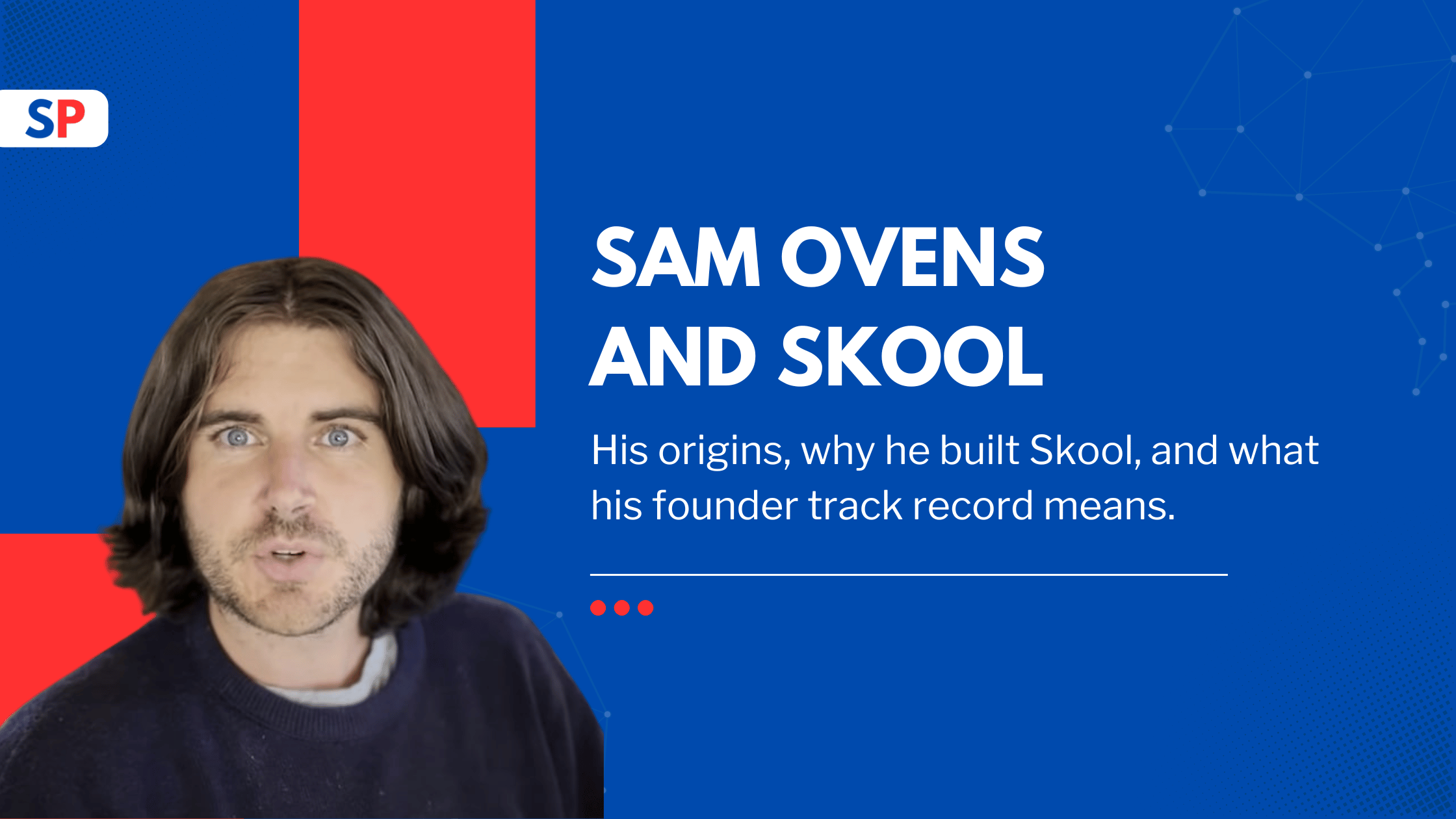
If you’ve been researching whether to start a community on Skool, you’ve probably run into Sam Ovens’s name at some point — usually attached to a high-energy YouTube video about how Skool is going to replace every course platform on the market. He’s the founder. He’s also a divisive figure, which makes it hard to know what’s signal and what’s marketing.
This post strips the hype out. Who is Sam Ovens, how did he end up building Skool, what’s his actual track record, and what does that mean for you if you’re thinking about building your community on his platform? If you want to skip to the action and try the platform itself, you can sign up for Skool here and see whether it lives up to the founder’s reputation.
Here’s the honest story.
Who Owns Skool?
Skool is owned and run by Sam Ovens, who founded the platform in 2019 and remains its CEO today. Alex Hormozi joined as a partner and equity holder in 2023. The company is privately held — it has never been acquired and has no public shareholders — with a reported valuation of over $1B as of 2024–2025.
So if you’re asking who founded Skool, who owns it now, and whether the person behind it is someone worth betting your community on — it’s the same answer, and the rest of this post is his story.
Who Is Sam Ovens?
Sam Ovens is a New Zealand-born entrepreneur, now based in the US, best known as the founder and CEO of Skool. Before Skool, he built and ran Consulting.com, an online education business that generated hundreds of millions of dollars in revenue teaching people how to start consulting businesses.
The short biography:
- Started selling consulting services from his parents’ garage in Auckland in his early twenties
- Pivoted from offering consulting to teaching others how to consult
- Built Consulting.com into one of the most successful online education businesses of the 2010s
- Launched Skool in 2019 to solve the community + course problem he kept running into with his own students
- Skool exploded in popularity from 2022 onwards, hitting a reported $1B+ valuation by 2024–2025
He’s known for direct, no-nonsense business advice; a polarising YouTube presence; and a high-conviction product vision for Skool that has consistently shipped features creators actually want.
Why Sam Ovens Built Skool
This is the part most people miss. Skool wasn’t built as a community platform first. It was built because Consulting.com kept running into the same problem: students needed a place to learn (a course), a place to ask questions and get help (a community), and a place to attend live calls and events. The available options — Teachable + Facebook Group + Zoom + Stripe + email — were all separate tools held together with duct tape.
Sam’s bet was that if you combined those into one product, with the right design, you’d build something so much better than the alternative that it would take over the category. That’s exactly what’s happened.
The reason Skool feels different from Circle, Mighty Networks, or Discord isn’t a clever feature. It’s that the entire product was built top-down by someone who’d actually run a $100M+ online education business and knew what was missing.
Sam Ovens’s Track Record Before Skool
Sam’s Consulting.com years are important context because they’re the foundation of his credibility — and the source of most of the controversy.
Wins:
- Consulting.com generated hundreds of millions in revenue selling consulting training
- He built and sold a real consulting business himself before teaching it
- He scaled his business publicly, sharing real numbers, marketing experiments, and product decisions
- His students included thousands of consultants who built real six- and seven-figure businesses
Criticisms:
- High-priced courses ($2K–$15K) attracted complaints about pricing and aggressive sales tactics
- Refund policies were strict — typical for high-ticket info products but a sore spot for people who felt the product didn’t match the pitch
- Like most info-product creators, the loud success stories sat alongside many people who paid and didn’t get results
If you read the Reddit threads or the negative reviews, you’ll see a familiar shape: a polarising founder who built real things, who also operated in a controversial category. Decide for yourself how much weight to give that — but don’t confuse “high-ticket info product” with “Skool itself.”
Skool the product is genuinely good. That’s why it’s grown faster than every competitor in the category combined.
How Skool Has Grown Under Sam’s Leadership
Skool’s growth curve is one of the steepest in the community-platform space since the early days of Discord. Some markers that matter:
- Launched in 2019, but the inflection point was 2022–2023 when Skool’s product-market fit became obvious
- Alex Hormozi joined as a partner / equity holder in 2023, bringing meaningful distribution
- Reported $1B+ valuation by 2024–2025 based on revenue multiples
- Powers thousands of creator communities, including many of the best-known names in the online business space
- Hosts “Skool Games” — a recurring competition with prizes (including a free McLaren in past iterations) that has become the loudest creator community marketing event of the year
The product has shipped consistently: native live calls, the Classroom redesign, gamification refinements, the Hobby plan, the affiliate program, custom domains on Hobby. Each release lines up with what creators were already asking for — which is what you’d expect from a CEO who actually uses the product.
What This Means If You’re Building on Skool
The founder story matters because it tells you whether the platform you build on is going to keep getting better, stay neutral, or quietly rot. With Skool, the signal is clear: aligned founder, real product velocity, and a category-defining brand. That’s the right base to build on. You can spin up a community here and start in the same product the founder built for his own students.
A few practical implications:
1. The product roadmap is opinionated
Skool ships features quickly but selectively. Sam has been public about preferring to do fewer things very well rather than building a Swiss-army-knife platform. That’s why Skool doesn’t have CRM tools, advanced automations, or extreme design customisation — and won’t.
If you need those things, build them around Skool, not on top of it. If you can live without them, the simplicity is the point.
2. The brand has gravity
A non-trivial number of new Skool community sign-ups come from people searching “Skool” by name, watching Skool Games, or being referred by Hormozi or another high-profile owner. That’s tailwind you don’t get on Circle or Mighty Networks.
3. The platform is built for course + community owners
Sam built Skool to solve his own problem at Consulting.com — running courses and a community side-by-side. If that’s also your model (coaching + community, course + mastermind, education + accountability), you’re using a tool designed for exactly what you do.
If you’re trying to build something completely different — a community-only Discord replacement, a free-only forum, a fan club without a learning component — Skool will work but it’s not optimised for that.
4. Pricing decisions are creator-friendly
The April 2026 update that moved custom domain and the affiliate program onto the $9 Hobby plan is a good example. Skool could have kept those features locked at $99/month and milked the margin. They didn’t. That’s a signal about how the founder thinks about creator economics — and why so many creators have moved over.
Sam Ovens vs Other Platform Founders
Quick comparison to give you a sense of the field.
| Platform | Founder | Background | Founder credibility for course + community owners |
|---|---|---|---|
| Skool | Sam Ovens | Built Consulting.com — used the platform for his own business | High |
| Circle | Sid Yadav | Ex-Teachable team — community-first focus | High |
| Mighty Networks | Gina Bianchini | Ex-Ning — long history in social platforms | High |
| Discord | Jason Citron | Gaming background, expanded to communities | Mixed (not built for monetisation) |
| Whop | Cameron Zoub | Marketplace background | Mixed (different model) |
| Kajabi | Kenny Rueter | Course platform background | High for courses, lower for community |
The thing that makes Sam different from most of these founders is operator credibility in the exact niche he serves. Most platform founders are technologists who saw a market. Sam was the customer first.
The Honest Take on Sam Ovens
If you’re trying to decide whether you trust the person running the platform you’re about to build on:
- The product is excellent and getting better
- The founder is opinionated and uses the product
- The brand has real momentum and won’t fade soon
- Some of the marketing around Sam himself (and around Skool Games) is loud — judge the product, not the YouTube intro
- The category is still expanding; betting on the category leader is the right call
You don’t have to be a Sam Ovens fan to use Skool. Plenty of people who roll their eyes at the high-energy marketing still use the product because it’s the best thing in the category. That’s the right way to think about it — separate the marketing from the platform. Try Skool here and judge for yourself.
Why This Matters for the Course + Community Use Case
Skool’s entire reason to exist comes back to the Consulting.com problem: how do you teach something to people while also giving them a place to talk, support each other, and stick around long enough to actually finish the work?
That’s what Skool solves better than any competitor:
- Classroom for structured learning (modules, video, drip content, progress)
- Community feed for ongoing discussion, accountability, peer help
- Calendar for live events that pull people back in
- Calls for live group sessions (no Zoom dance)
- Gamification to drive engagement without manual effort
- Mobile app so members engage between sessions on their phones
Every one of these features traces back to a real pain Sam hit running Consulting.com. That’s why Skool feels integrated where competitors feel assembled.
If you’re building anything that combines education and community in 2026, the founder story should give you more confidence, not less: the platform is built by an operator who solved this exact problem at scale, not a venture-backed team building features by committee. Start your community on Skool here.
FAQ
Who owns Skool?
Who founded Skool?
Did Sam Ovens really build Skool from scratch?
Is Sam Ovens still actively running Skool?
What’s Sam Ovens’s net worth?
Why is Alex Hormozi involved with Skool?
Is Sam Ovens controversial?
Should the founder’s reputation matter when I’m picking a platform?
Free tool
Decided Skool is the right fit?
Here’s your next step. The free Skool Launch Planner turns your topic into a complete launch plan — positioning, pricing, outreach scripts and a 7-day roadmap to your first 20 members. About 2 minutes, no signup needed.